Maintenance
Updated August 2026   |   Educational guide
Industrial warehouse racking requiring preventive maintenance and periodic inspection

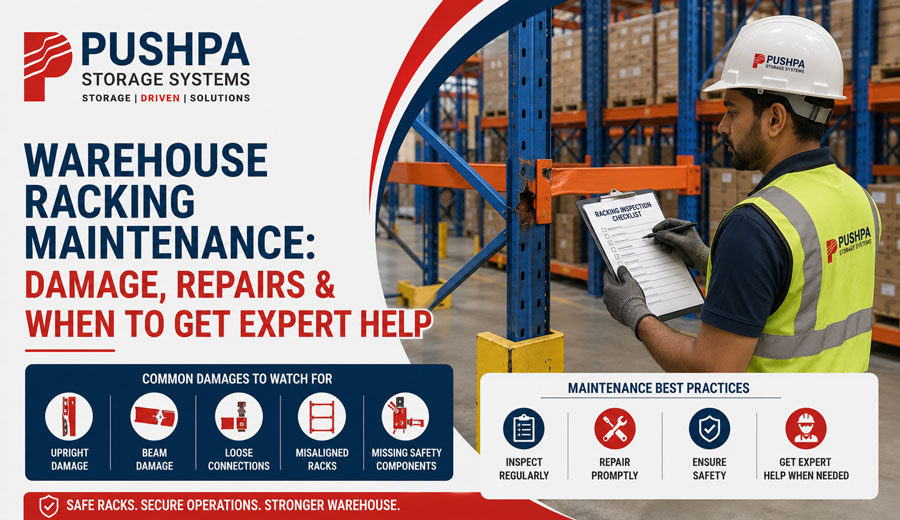
Racking works in a demanding environment. Forklifts, pallet movement and changing inventory can damage components over time, so maintenance should be planned rather than left until a visible problem becomes severe.

Create a simple process for staff to report impacts, bent members, displaced beams, loose anchors or missing components. Damaged areas may need unloading or isolation until they can be assessed.

Warehouse Racking Planning Process

1. AssessInventory, loads & goals
2. MeasureSpace, height & aisles
3. DesignLayout & rack selection
4. InstallAnchoring & setup
5. InspectUse, review & maintain

Avoid unapproved cutting, welding, drilling or component substitution. Changes that appear minor can alter how loads are transferred through the structure. Repairs and modifications should follow appropriate engineering or manufacturer guidance.

Keep records of inspections and corrective actions. This makes recurring impact locations easier to identify and can reveal whether guards, layout changes or operator training are needed to prevent repeated damage.

Planning note: Rack capacities, dimensions and layouts must be based on actual loads, site conditions and handling requirements. Obtain a project-specific assessment before installation or modification.

Frequently Asked Questions (FAQs)

Maintenance helps identify impact damage, loose components, corrosion, altered configurations and other issues before they become larger operational or safety problems.
Teams can perform regular visual checks when trained, while formal or technical assessments should be handled by appropriately competent personnel.
High-traffic aisle ends, lower uprights, beam connections, anchors, guards and locations with recurring forklift interaction deserve particular attention.
Use compatible, approved components. Mixing unverified parts or modifying members can change system behaviour and rated capacity.
Contact a competent supplier when damage, instability, repeated impacts, configuration changes, overloading concerns or expansion requirements are identified.

Educational information only. Final rack capacity, layout, anchoring and structural requirements must be confirmed for the actual site and load conditions.