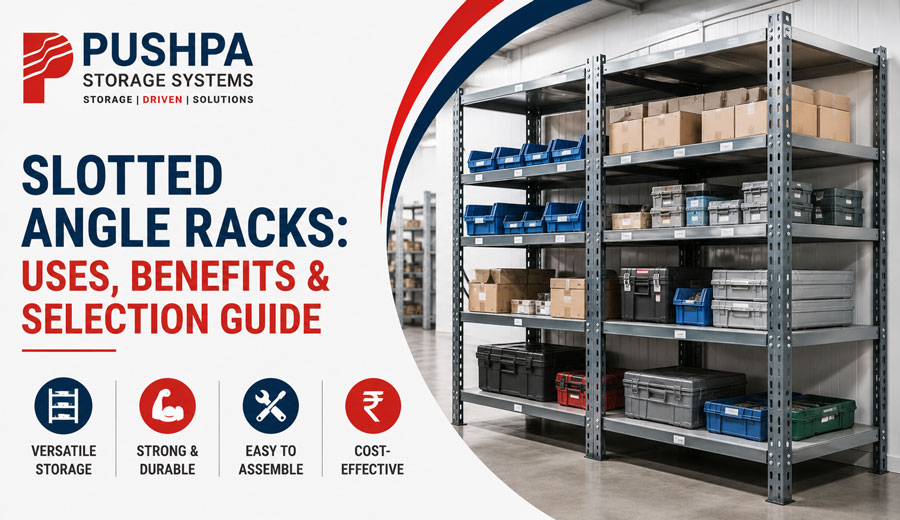
Slotted Angle Racks
Updated August 2026   |   Educational guide
Adjustable slotted angle shelving racks for organised small and medium goods storage

Slotted angle racks are a flexible storage option for cartons, spare parts, tools, files and other manually handled goods. Their modular construction makes them useful where shelf heights or bay configurations may need adjustment.

The correct design depends on the load per shelf, shelf dimensions, number of levels and overall height. A rack intended for light cartons should not be assumed suitable for dense components simply because the dimensions are similar.

Warehouse Racking Planning Process

1. AssessInventory, loads & goals
2. MeasureSpace, height & aisles
3. DesignLayout & rack selection
4. InstallAnchoring & setup
5. InspectUse, review & maintain

Think about how staff will pick from the rack. Frequently accessed products should be positioned at convenient heights, while heavier items are generally easier to handle safely at lower levels. Clear labelling can further improve retrieval.

For growing stores and warehouses, modularity is a major advantage. Planning consistent bay sizes and keeping future expansion in mind can make later reconfiguration easier.

Planning note: Rack capacities, dimensions and layouts must be based on actual loads, site conditions and handling requirements. Obtain a project-specific assessment before installation or modification.

Frequently Asked Questions (FAQs)

They are commonly used for boxes, spare parts, files, tools and other small-to-medium goods that benefit from adjustable shelf levels.
Yes. The perforated upright system allows shelf levels to be configured and changed, within the limits of the design and load requirements.
They are available in different configurations, but very high loads may require a purpose-designed heavy-duty system. Actual load requirements should be assessed before selection.
They are relatively flexible, but extensions and modifications should remain compatible with the original structure and safe load configuration.
Base dimensions on the stored items, handling clearance, available room size and load per shelf rather than choosing only by available floor area.

Educational information only. Final rack capacity, layout, anchoring and structural requirements must be confirmed for the actual site and load conditions.