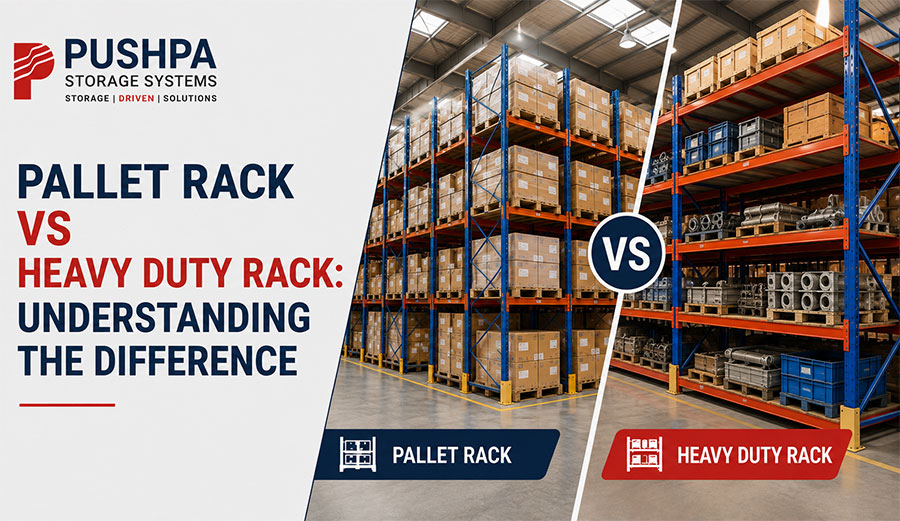
Rack Comparison
Updated August 2026   |   Educational guide
Comparison of pallet racking and heavy duty industrial storage rack applications

The terms pallet rack and heavy duty rack are sometimes used loosely, but the intended handling method is an important distinction. Pallet racking is designed around palletised unit loads and mechanical handling, while heavy duty shelving or rack configurations may be used for bulky goods, cartons or components depending on the engineered design.

Start with the load form. If goods remain on pallets and are handled by forklift, pallet dimensions, maximum pallet weight and aisle requirements are central. If items are manually loaded or stored as individual units, shelf depth, ergonomic access and load per level may matter more.

Warehouse Racking Planning Process

1. AssessInventory, loads & goals
2. MeasureSpace, height & aisles
3. DesignLayout & rack selection
4. InstallAnchoring & setup
5. InspectUse, review & maintain

Neither category should be selected by name alone. Ask for the rated capacity and configuration for the actual application. Rack height, bay width, number of levels and floor conditions all influence the final design.

Choosing based on workflow reduces handling effort and helps avoid paying for a system that does not match how the warehouse operates.

Planning note: Rack capacities, dimensions and layouts must be based on actual loads, site conditions and handling requirements. Obtain a project-specific assessment before installation or modification.

Frequently Asked Questions (FAQs)

Pallet racking is primarily configured around palletised unit loads and forklift access, while heavy-duty shelving can also be configured for bulky cartons, components and manually or mechanically handled goods.
Neither is universally better. The right system depends on whether goods are palletised, load dimensions, access frequency, handling method and available space.
Some engineered heavy-duty configurations may accommodate palletised loads, but pallet storage should be assessed specifically for pallet support, handling and load conditions.
Both can use vertical space effectively when properly designed. Building clear height, handling equipment and access requirements determine the practical number of levels.
No. Compare design suitability, load rating, layout efficiency, installation, safety provisions, expandability and lifecycle support along with price.

Educational information only. Final rack capacity, layout, anchoring and structural requirements must be confirmed for the actual site and load conditions.